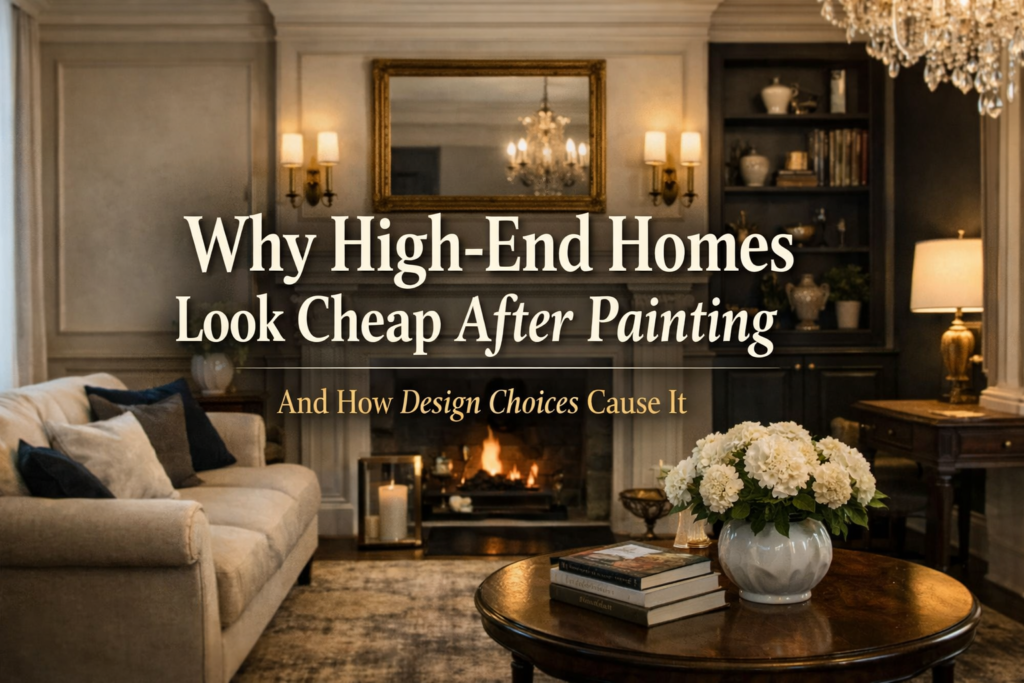
Design Decisions Matter More Than Paint Quality
Even the most expensive homes can look underwhelming after painting, and it’s rarely because of poor workmanship or cheap materials. More often, overlooked design decisions cause the problem long before the first coat goes on.
In high-end interiors, professional interior painting is less about the paint itself and more about how color, contrast, and finish choices interact with architecture, light, and furnishings. When those elements fall out of balance, the space feels flat, dated, or surprisingly inexpensive, no matter how much investment exists elsewhere.
Understanding why this happens requires looking beyond trends and focusing on how paint functions as a design element, not just a finishing step.
Design Decisions Matter More Than Paint Quality
Paint often serves as a finishing touch, but in high-end homes it functions more like a design framework. It sets the tone for how every surface, material, and detail reads. Without a broader design context, even well-executed work can fall flat.
This is why expensive homes sometimes lose their sense of refinement after painting. The issue is rarely the paint itself. It’s how that paint interacts with the space as a whole.
Color Choices Without Context
Color trends move fast, but architecture does not. A shade that looks striking online or in a showroom can feel disconnected once it’s applied to a real space with fixed proportions, natural light patterns, and permanent materials.
High-end interiors demand restraint. Paint should support the architecture, not compete with it. When color is chosen in isolation, without considering ceiling height, trim scale, or how rooms connect visually, the result can feel fragmented or unintentionally dramatic.
Design-forward painting starts with context, not preference.
When Trim Is Treated as an Afterthought
Trim plays a quiet but critical role in how a space reads. It defines transitions, frames openings, and establishes visual rhythm. Yet it’s often treated as secondary to wall color, when in reality it has just as much influence on perceived quality.
In high-end homes, trim decisions affect whether a room feels intentional or unfinished. Contrast that’s too sharp can feel harsh. Trim that blends without purpose can feel dull. The difference is rarely obvious to homeowners, but it’s immediately noticeable to professionals who understand how fine finish trim work contributes to the overall design language of a home.
Trim isn’t just detail work. It’s part of the composition.
Sheen Inconsistency and Visual Noise
Sheen is one of the fastest ways to undermine an otherwise refined space. When walls, trim, and doors reflect light differently without intention, the eye picks up inconsistency, even if the color palette is sound.
High-end interiors rely on controlled reflection. Subtle shifts in sheen can enhance depth, but random variation creates visual noise. Doors that flash under light, trim that feels plasticky, or walls that absorb too much can all throw off the balance of a room.
These are small decisions with outsized impact.
Over-Designed Concepts With Weak Execution
Complex ideas demand precision. Bold color schemes, monochromatic rooms, or layered neutrals only work when execution matches the ambition of the design.
When finish quality doesn’t support the concept, the space feels unfinished rather than intentional. This is where the difference between paint as a product and professional interior painting as a discipline becomes clear. High-end results depend on alignment between design intent and execution standards.
Sophistication comes from consistency, not excess.
What Professionals Notice Immediately in High-End Homes
After years of working in luxury interiors, certain signals stand out instantly. Transitions that feel abrupt. Finishes that don’t age well. Spaces where the paint draws attention instead of quietly supporting the design.
These details rarely jump out to homeowners until something feels “off.” By then, the issue is harder to articulate, but the impression has already been made. Paint, when handled correctly, disappears into the background. When mishandled, it becomes the first thing people notice.
Paint as a Design Decision
High-end painting is not about chasing trends or showcasing technique. It’s about understanding how color, finish, and restraint shape the experience of a space.
When paint is treated as a design decision rather than a final step, the result feels cohesive, intentional, and timeless. That’s the difference between a home that looks expensive and one that simply is.
Like this:
Like Loading...