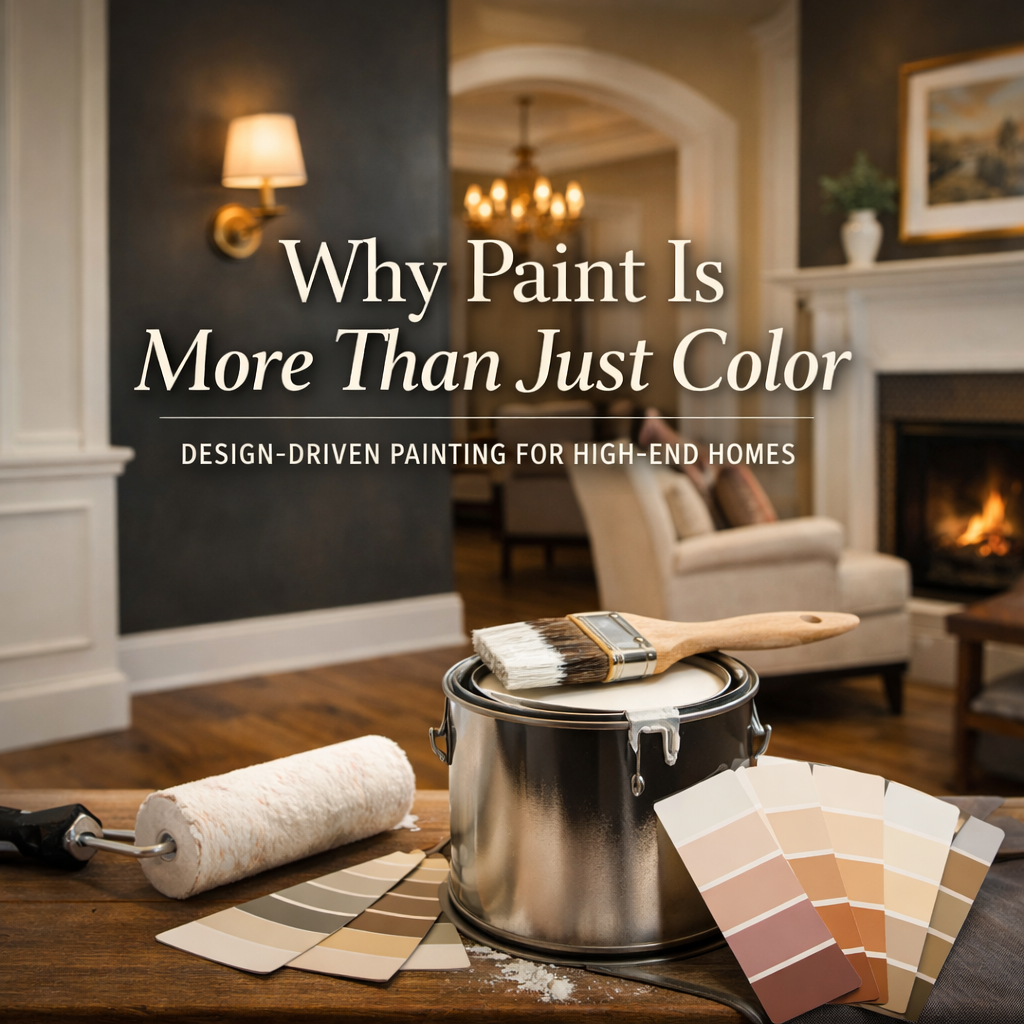
Painting Is Not the Final Step, It’s Part of the Design
Most people think paint is just about color. Pick a shade, apply it, and move on.
That assumption is why many freshly painted homes still feel unfinished. When paint is treated as a commodity instead of a design element, even good colors fall flat. High-quality results come from approaching painting as part of the design process, not just a task to check off at the end of a project.
Paint influences how light moves through a space, how architectural details stand out, and how refined a room ultimately feels.
Painting done well is intentional.
Painting done cheaply is reactive.
Basic painting answers one question: is the surface covered?
Design-driven painting answers many more:
- How does this color react to natural and artificial light?
- Where should contrast exist, and where should it quietly disappear?
- Which surfaces should stand out and which should blend into the background?
- How do walls, trim, ceilings, and doors work together visually?
Paint does not exist in isolation. It interacts with flooring, cabinetry, hardware, furniture, and lighting throughout the day. This is why professional interior painting should always be approached as part of the overall design, not just a surface-level update.
Color Choice Is Only Part of the Equation
Homeowners often spend weeks choosing colors and almost no time considering the other factors that affect how those colors look once applied.
Sheen, surface condition, and transitions matter just as much as hue.
- Sheen controls light. Matte absorbs imperfections. Satin reflects movement. Semi-gloss draws attention, whether intended or not.
- Surface preparation controls perception. A flawless color applied over poor drywall still looks cheap.
- Transitions define quality. Ceilings, trim, doors, and accent areas should feel deliberate, not accidental.
When these elements are designed together, spaces feel cohesive instead of simply painted.
Why White Paint Is One of the Hardest Choices
White is often chosen because it feels safe. In reality, it is one of the most revealing colors you can use.
White exposes:
- Uneven walls
- Poor patching
- Inconsistent sheen
- Sloppy cut lines
Design-focused painting treats white as a range, not a single color. Warm whites soften cooler rooms. Clean whites sharpen modern spaces. Ceiling whites are often intentionally different from wall whites.
When white is chosen and applied with intention, spaces feel calm and refined. When rushed, everything feels slightly off even if it is difficult to pinpoint why.
Trim, Doors, and Ceilings Shape the Entire Space
One of the most common mistakes is treating trim and doors as afterthoughts.
Design-driven painting considers:
- Whether trim should contrast or blend with the walls
- If doors should anchor the room or visually disappear
- When ceilings should brighten a space or subtly change its proportions
Proper trim painting plays a major role in defining a space, controlling contrast, and reinforcing architectural details. Often, the most impactful design choice is not a bold wall color, but how these elements are finished.
This is where craftsmanship quietly shows.
Surface Preparation Is Part of Interior Design
Design is not just about color. It is about surface quality.
Uneven texture, rushed repairs, or poor sanding will always undermine even the best color palette. Clean, consistent surfaces create the foundation design depends on.
That is why drywall repair, texture matching, and proper preparation are not optional extras. They are part of the visual outcome.
A simple color on a flawless surface will always outperform a bold color on a flawed one.
Design Expectations in Higher-End Homes
We see this most often in higher-end homes throughout Whitefish Bay, Fox Point, Brookfield, and Oconomowoc Lake, where homeowners expect paint to function as part of the overall design rather than just a surface finish. In these areas, details like sheen selection, wall preparation, and how trim and ceilings interact with the space make a noticeable difference in how refined the final result feels.
In homes like these, painting is not about speed. It is about precision and long-term appearance.
Why Cheap Painting Rarely Holds Up
Low-cost painting focuses on speed and coverage. Design-driven painting focuses on outcome.
Corners get rushed. Preparation gets minimized. Materials get substituted. The work may look acceptable at first, but light, wear, and time expose shortcuts quickly.
High-quality painting takes longer because it is deliberate. The goal is not how fast the job is finished, but how it looks years later.
How to Tell If a Painter Thinks Like a Designer
You can usually tell early in the conversation.
A design-minded painter will:
- Ask how the space is used, not just what color you want
- Talk about light, sheen, and transitions
- Care about surface condition before paint goes on
- Push back when something will not look right
A production painter focuses almost entirely on square footage and gallons.
Neither approach is accidental. Only one produces consistently refined results.
Why the Approach Matters
Paint is one of the most powerful design tools in a home when it is used intentionally.
When painting is approached as design, spaces feel cohesive, balanced, and finished. When it is treated as a commodity, even premium colors lose their impact.
The difference is not the paint itself.
It is the thinking behind it.
Like this:
Like Loading...